Biography
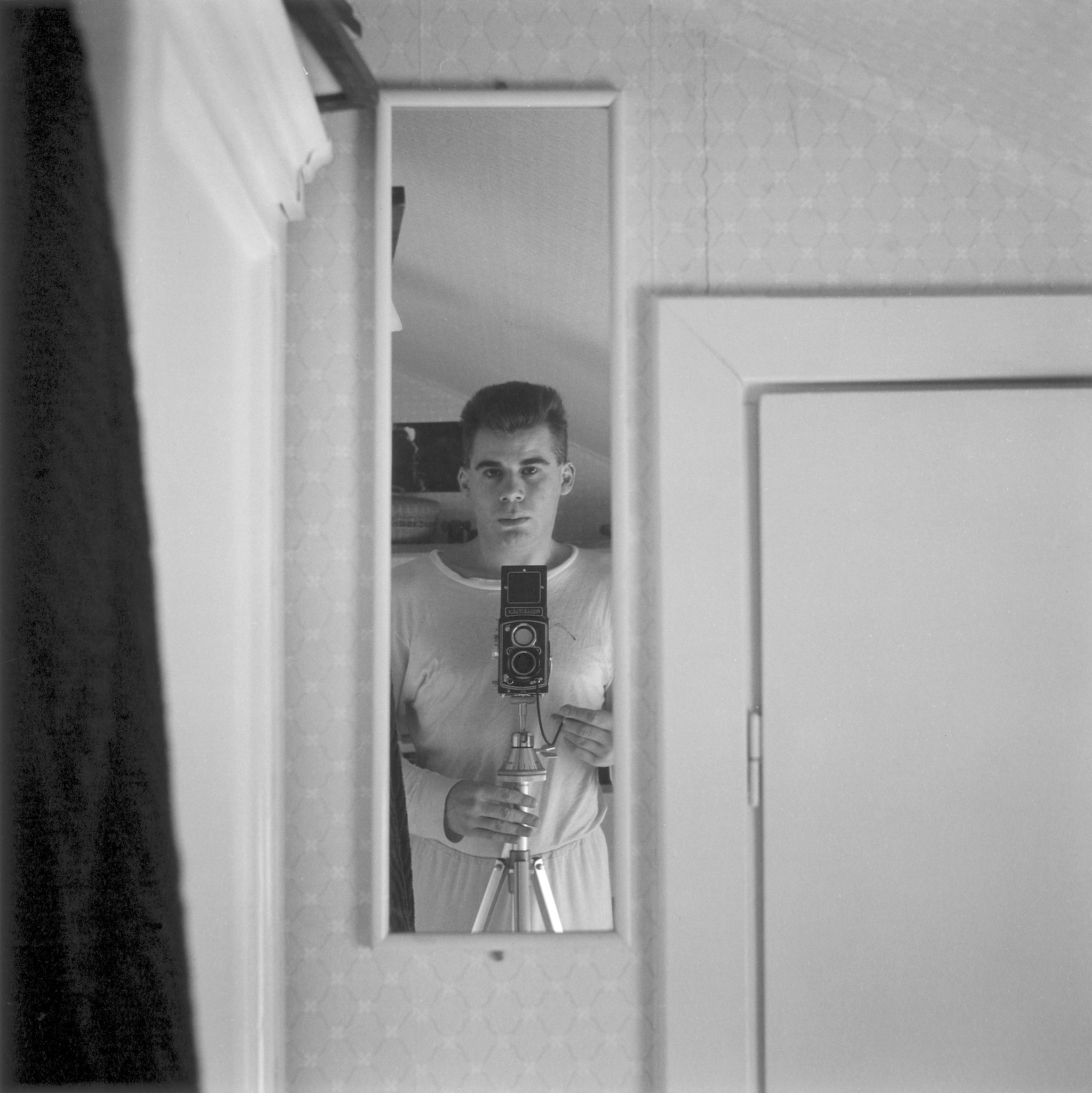
1933: Gunnar Smoliansky was born in Visby (on the Swedish island of Gotland), the only child of Mary and Suska Smoliansky. His father was a pianist by profession and was working, at the time of Gunnar’s birth, on the island of Gotland.
1935: The Smolianskys returned to Stockholm, sharing a house for the next fifteen years with Mary’s parents in the suburb of Lidingö.
1950: The Smolianskys moved to a home of their own in Saltsjö-Boo.
1951: Gunnar Smoliansky dropped out of upper secondary school. Thanks to his friend Bror Svärd he discovered the potential and mysteries of the photo darkroom, and began to see the possibility of working as a photographer. He purchased his first camera, a Rolleiflex.
1952: Gunnar Smoliansky was employed as a customs official at the Stockholm port of Stadsgårdshamnen. He began to take photos on his way to and from work, producing his first photographic series.
1954: Gunnar Smoliansky and Bror Svärd made their way to São Paolo, where he worked as assistants to industrial photographer Leon Lieberman. Although Gunnar had his Rolleiflex with him in São Paolo, he only photographed sporadically.
1956: Gunnar Smoliansky returned to Sweden and was employed as an industrial photographer at Atlas Copco. He also took an evening course with renowned photographer Christer Strömholm. This encounter, and making the acquaintance of the other participants, including Tor Ivan Odulf, was decisive to Gunnar Smoliansky’s future orientation as a photographer. In this context, he also met photographer Walter Hirsch, with whom he has had a lifelong friendship.
1962: Gunnar Smoliansky married jazz vocalist Nannie Porres, whom he met through Walter Hirsch in 1959. Through Nannie, a number of the most outstanding Swedish jazz musicians of the era became family friends. Birth of Gunnar and Nannie’s son Peter.
1965: Concluded his employment with Atlas Copco to become a freelance photographer. His main clients were publishers of textbooks. Gunnar Smoliansky had already developed quite a sophisticated use of imagery, often suitable for this type of work.
1968: The newsletter of RFSU (RFSU-bulletinen), the Swedish Association for Sexual Education, became one of Gunnar Smoliansky’s main clients. In this context he collaborated with Erik Centerwall. Together, they also produced two books on high topical subjects: Livstid – om manlig längtan och förnekelse [Lifetime, On Men’s Desire and Denial] and Mansbilder [Images of Men].
1971: Gunnar Smoliansky’s first solo show, Rombilder [Pictures of Rome], was organized at the initiative of Annagreta and Erik Dyring in Uppsala, Sweden.
1972: Gunnar Smoliaknsky and Nannie Porres moved into to his parents’ former home in Saltsjö-Boo.
1973: Gunnar Smoliansky met sculptor Lars Kleen during his major sculpture exhibit at the Stadsgårdshamnen port. Gunnar Smoliansky’s photos from this show were the beginning of a lifelong collaboration between the two.
1974: Gunnar Smoliansky and Nannie Porres separated. Gunnar met photographer Stina Brockman.
1975: Gunnar Smoliansky established the photo agency Bildhuset in collaboration with others, including Walter Hirsch and Björn Myrman. Bildhuset became an important venue for contemporary photography.
1978: Gunnar Smoliansky became acquainted with photographers Dawid (Björn Dawidsson) and Ottmar Thorman. This creative friendship triggered the renewal of the Swedish photography scene, and a break with 35 mm photography, which otherwise characterized the 1970s. For example, they found new inspiration in more traditional techniques and used larger formats.
1979: Through Dawid, Gunnar met photographer Gerry Johansson. The three became close friends, and also worked together with the Bildhuset agency and, later, with DOG, a photo publishing house.
1980: Gunnar Smoliansky was awarded the annual PHOTO magazine prize, “Stora Fotografpriset”.
1982: In collaboration with his friends Walter Hirsch and Dawid, Gunnar Smoliansky established the DOG photo publishing house. His own first book, Barn [Children], was published by DOG this same year, as was Walter Hirsch’s Avd.9, [Ward 9], followed by Dawid’s Rost [Rust]. Birth of Gunnar and Stina’s son David.
1985: Gunnar Smoliansky’s photographs were exhibited at Kim Klein’s Galleri Barbar in Stockholm. Collaboration with Kim Klein continued, resulting in an exhibit entitled Promenadbilder [Promenade Pictures] at the Stockholm Museum of Modern Art, Moderna Museet, in 1986 and in another, Vi ses igen [See You Again] at Lido in Stockholm in 1987. These three shows confirmed Gunnar Smoliansky’s status in Swedish photography, and were seminal to the continued development of the Gunnar Smoliansky’s personal style of photography.
1986: Gunnar Smoliansky married photographer Stina Brockman, they lived together until 1993.
1990: Gunnar Smoliansky was granted a “state income guarantee for artists” for his contributions to photography. Birth of Gunnar and Stina’s daughter Kajsa.
1991: Gunnar Smoliansky was commissioned to make a photographic portrayal of Waldemarsudde, today an art museum and originally the home of the artist, Prins Eugen of Sweden, son of King Oscar II (1865-1947). Hans Henrik Brummer, curator at Waldemarsudde, took an interest in the photography of Gunnar Smoliansky. This interest eventually resulted in three exhibitions: Gunnar Smolianskys fotografier från Slussen 1952 [Gunnar Smoliansky’s Photographs from Slussen 1952] (2002), Waldemarsudde (2004) and Centralen Vårvintern 1956 [Stockholm Central Station, Early Spring 1956] (2006). The Waldemarsudde exhibition also took the form of a book of photographs, with texts by Hans Henrik Brummer.
1998: After having been commissioned to photograph for the journal Stockholm New, Gunnar Smoliansky began to collaborate with art director Henrik Nygren. They produced books together, including Slussen (2002), Waldemarsudde (2004) and Sotbrand [Soot Fire] (2006).
2005: Gunnar Smoliansky was awarded the Lennart af Petersens Prize by the City of Stockholm.
2008: The exhibition En Bild i Taget [One Picture at a Time] was shown at the Hasselblad Center. The exhibition was produced in collaboration between Gunnar Smoliansky, Jäger Arén, Henrik Nygren and Greger Ulf Nilson for the Hasselblad Foundation. The exhibition was later shown at Kulturhuset (2008), Dunkers Kulturhus (2010), Långbans Moderna Wärmlands Museum (2012), Shoot Gallery (2013), Fabriken Bästekile (2014) and Tomelilla Konsthall (2020).
2009: The book One Picture at a Time was published by the German publisher Steidl. The book was based on the photographic material from the exhibition En Bild i Taget, and the contributors were the same as for the exhibition. This was Gunnar Smoliansky’s first international publication and also the first retrospective book devoted to his photographic oeuvre. Deutsche Börse Photography Foundation purchases a number of Gunnar’s images for its collection.
2010: Fondation Hermès acquired a collection of Gunnar Smoliansky’s photographs.
2011: GUN Gallery presented the exhibition Promenadbilder [Promenade Pictures]. Gunnar Smoliansky was awarded the Prince Eugen Medal, presented by Carl XVI Gustaf.
2013: Gunnar Smoliansky exhibited at Michael Hoppen Gallery in London.
2016: The book Signs and Traces was published by Only Photography, accompanied by an exhibition at their gallery in Berlin.
2017: The book Träd [Trees] was published by Libraryman. Gunnar Smoliansky presented the exhibition Flanören [The Flâneur] at Forum, curated by Kim Klein. Gerry Johansson and Jäger Arén produced the book Diary, published at the end of the year — the last book project in which Gunnar himself participated.
2019: On 12 December, Gunnar Smoliansky passed away after a period of illness at his home in Saltsjö-Boo.
1935: The Smolianskys returned to Stockholm, sharing a house for the next fifteen years with Mary’s parents in the suburb of Lidingö.
1950: The Smolianskys moved to a home of their own in Saltsjö-Boo.
1951: Gunnar Smoliansky dropped out of upper secondary school. Thanks to his friend Bror Svärd he discovered the potential and mysteries of the photo darkroom, and began to see the possibility of working as a photographer. He purchased his first camera, a Rolleiflex.
1952: Gunnar Smoliansky was employed as a customs official at the Stockholm port of Stadsgårdshamnen. He began to take photos on his way to and from work, producing his first photographic series.
1954: Gunnar Smoliansky and Bror Svärd made their way to São Paolo, where he worked as assistants to industrial photographer Leon Lieberman. Although Gunnar had his Rolleiflex with him in São Paolo, he only photographed sporadically.
1956: Gunnar Smoliansky returned to Sweden and was employed as an industrial photographer at Atlas Copco. He also took an evening course with renowned photographer Christer Strömholm. This encounter, and making the acquaintance of the other participants, including Tor Ivan Odulf, was decisive to Gunnar Smoliansky’s future orientation as a photographer. In this context, he also met photographer Walter Hirsch, with whom he has had a lifelong friendship.
1962: Gunnar Smoliansky married jazz vocalist Nannie Porres, whom he met through Walter Hirsch in 1959. Through Nannie, a number of the most outstanding Swedish jazz musicians of the era became family friends. Birth of Gunnar and Nannie’s son Peter.
1965: Concluded his employment with Atlas Copco to become a freelance photographer. His main clients were publishers of textbooks. Gunnar Smoliansky had already developed quite a sophisticated use of imagery, often suitable for this type of work.
1968: The newsletter of RFSU (RFSU-bulletinen), the Swedish Association for Sexual Education, became one of Gunnar Smoliansky’s main clients. In this context he collaborated with Erik Centerwall. Together, they also produced two books on high topical subjects: Livstid – om manlig längtan och förnekelse [Lifetime, On Men’s Desire and Denial] and Mansbilder [Images of Men].
1971: Gunnar Smoliansky’s first solo show, Rombilder [Pictures of Rome], was organized at the initiative of Annagreta and Erik Dyring in Uppsala, Sweden.
1972: Gunnar Smoliaknsky and Nannie Porres moved into to his parents’ former home in Saltsjö-Boo.
1973: Gunnar Smoliansky met sculptor Lars Kleen during his major sculpture exhibit at the Stadsgårdshamnen port. Gunnar Smoliansky’s photos from this show were the beginning of a lifelong collaboration between the two.
1974: Gunnar Smoliansky and Nannie Porres separated. Gunnar met photographer Stina Brockman.
1975: Gunnar Smoliansky established the photo agency Bildhuset in collaboration with others, including Walter Hirsch and Björn Myrman. Bildhuset became an important venue for contemporary photography.
1978: Gunnar Smoliansky became acquainted with photographers Dawid (Björn Dawidsson) and Ottmar Thorman. This creative friendship triggered the renewal of the Swedish photography scene, and a break with 35 mm photography, which otherwise characterized the 1970s. For example, they found new inspiration in more traditional techniques and used larger formats.
1979: Through Dawid, Gunnar met photographer Gerry Johansson. The three became close friends, and also worked together with the Bildhuset agency and, later, with DOG, a photo publishing house.
1980: Gunnar Smoliansky was awarded the annual PHOTO magazine prize, “Stora Fotografpriset”.
1982: In collaboration with his friends Walter Hirsch and Dawid, Gunnar Smoliansky established the DOG photo publishing house. His own first book, Barn [Children], was published by DOG this same year, as was Walter Hirsch’s Avd.9, [Ward 9], followed by Dawid’s Rost [Rust]. Birth of Gunnar and Stina’s son David.
1985: Gunnar Smoliansky’s photographs were exhibited at Kim Klein’s Galleri Barbar in Stockholm. Collaboration with Kim Klein continued, resulting in an exhibit entitled Promenadbilder [Promenade Pictures] at the Stockholm Museum of Modern Art, Moderna Museet, in 1986 and in another, Vi ses igen [See You Again] at Lido in Stockholm in 1987. These three shows confirmed Gunnar Smoliansky’s status in Swedish photography, and were seminal to the continued development of the Gunnar Smoliansky’s personal style of photography.
1986: Gunnar Smoliansky married photographer Stina Brockman, they lived together until 1993.
1990: Gunnar Smoliansky was granted a “state income guarantee for artists” for his contributions to photography. Birth of Gunnar and Stina’s daughter Kajsa.
1991: Gunnar Smoliansky was commissioned to make a photographic portrayal of Waldemarsudde, today an art museum and originally the home of the artist, Prins Eugen of Sweden, son of King Oscar II (1865-1947). Hans Henrik Brummer, curator at Waldemarsudde, took an interest in the photography of Gunnar Smoliansky. This interest eventually resulted in three exhibitions: Gunnar Smolianskys fotografier från Slussen 1952 [Gunnar Smoliansky’s Photographs from Slussen 1952] (2002), Waldemarsudde (2004) and Centralen Vårvintern 1956 [Stockholm Central Station, Early Spring 1956] (2006). The Waldemarsudde exhibition also took the form of a book of photographs, with texts by Hans Henrik Brummer.
1998: After having been commissioned to photograph for the journal Stockholm New, Gunnar Smoliansky began to collaborate with art director Henrik Nygren. They produced books together, including Slussen (2002), Waldemarsudde (2004) and Sotbrand [Soot Fire] (2006).
2005: Gunnar Smoliansky was awarded the Lennart af Petersens Prize by the City of Stockholm.
2008: The exhibition En Bild i Taget [One Picture at a Time] was shown at the Hasselblad Center. The exhibition was produced in collaboration between Gunnar Smoliansky, Jäger Arén, Henrik Nygren and Greger Ulf Nilson for the Hasselblad Foundation. The exhibition was later shown at Kulturhuset (2008), Dunkers Kulturhus (2010), Långbans Moderna Wärmlands Museum (2012), Shoot Gallery (2013), Fabriken Bästekile (2014) and Tomelilla Konsthall (2020).
2009: The book One Picture at a Time was published by the German publisher Steidl. The book was based on the photographic material from the exhibition En Bild i Taget, and the contributors were the same as for the exhibition. This was Gunnar Smoliansky’s first international publication and also the first retrospective book devoted to his photographic oeuvre. Deutsche Börse Photography Foundation purchases a number of Gunnar’s images for its collection.
2010: Fondation Hermès acquired a collection of Gunnar Smoliansky’s photographs.
2011: GUN Gallery presented the exhibition Promenadbilder [Promenade Pictures]. Gunnar Smoliansky was awarded the Prince Eugen Medal, presented by Carl XVI Gustaf.
2013: Gunnar Smoliansky exhibited at Michael Hoppen Gallery in London.
2016: The book Signs and Traces was published by Only Photography, accompanied by an exhibition at their gallery in Berlin.
2017: The book Träd [Trees] was published by Libraryman. Gunnar Smoliansky presented the exhibition Flanören [The Flâneur] at Forum, curated by Kim Klein. Gerry Johansson and Jäger Arén produced the book Diary, published at the end of the year — the last book project in which Gunnar himself participated.
2019: On 12 December, Gunnar Smoliansky passed away after a period of illness at his home in Saltsjö-Boo.